Dharma Buddhist Wisdom & Philosophy
01 / 07
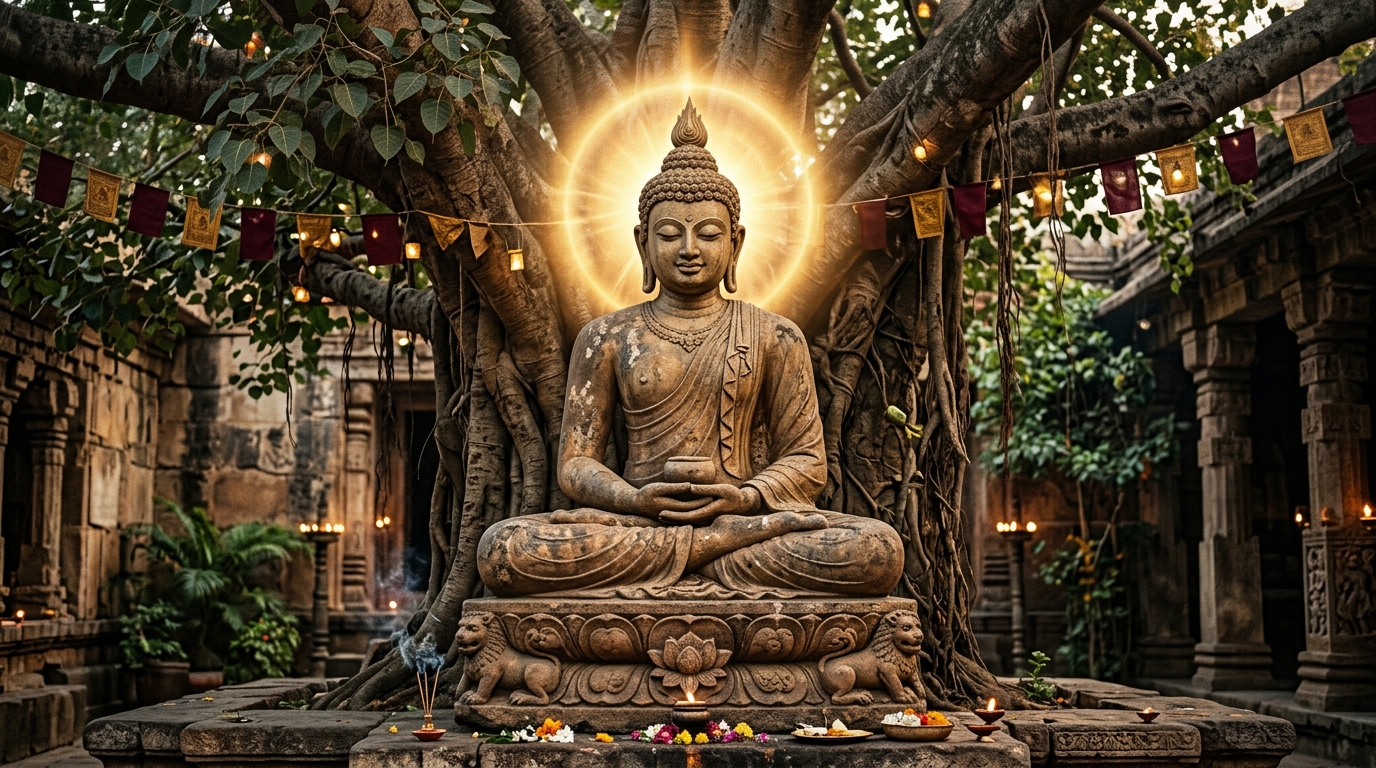
Sacred ancient statue of Gautama Buddha in meditation under the Bodhi tree
Origin & Awakening

The Middle Way & The Path to Awakening

Majjhima Paṭipadā — Navigating the Harmonious Center Beyond Extremes

Sacred Gautama Buddha in deep meditation under the Bodhi tree
Enlightenment at Bodh Gaya

"Neither by indulgence nor by torment is peace found; there is a Middle Way that leads to liberation."

The Great Realization

Born Prince Siddhartha Gautama in the Himalayan foothills of Kapilavastu, he was shielded in palaces of luxury. Upon witnessing the Four Sights—aging, sickness, death, and a wandering ascetic—he renounced royal privilege to confront universal human suffering.

After six years of severe asceticism failed to produce peace, Siddhartha realized the lute string tuned too tight snaps, while one too slack will not play. Seated beneath the Bodhi tree at Bodh Gaya, he discovered the Middle Way: an experiential balance cultivating direct awakening.

"Neither by indulgence nor by torment is peace found; there is a Middle Way that opens the eyes and leads to liberation." — First Discourse (Dhammacakkappavattana Sutta)
Ehipassiko "Come and see" — direct experiential inquiry.
Sammā Harmonious balance avoiding extremes.
Bodhi Awakening of compassion and insight.

Sacred atmospheric background
Diagnostic Wisdom

The Four Noble Truths

Chatvāri Āryasatyāni — The Universal Diagnosis and Cure for Existential Dissatisfaction

01

Dukkha

— The Truth of Suffering

Conditioned existence involves impermanence (anicca) and friction. Acknowledging grief, pain, and the unease of grasping fleeting moments is the first step toward freedom.

Prescription: To be fully understood
02

Samudaya

— The Origin of Suffering

Suffering arises from Taṇhā (craving or thirsty grasping): craving for transient pleasure, permanent ego, or aversion. Grasping illusions of permanence breeds discontent.

Prescription: To be abandoned at the root
03

Nirodha

— The Cessation of Suffering

Suffering has a definitive end. Nirvāṇa is the unconditioned state of peace that emerges when craving, hatred, and delusion are quenched, unlocking spiritual liberation.

Prescription: To be directly realized
04

Magga

— The Path to Cessation

The therapeutic method: The Noble Eightfold Path. It systematically trains wisdom, ethical conduct, and meditative mental discipline, transforming consciousness into continuous presence.

Prescription: To be cultivated daily
Sacred atmospheric background
Practical Blueprint

The Noble Eightfold Path

Ārya Aṣṭāṅgika Mārga — Eight Interdependent Spokes of Enlightened Living

Click spokes or path tags to explore teachings

Prajñā (Wisdom)

Discernment

Śīla (Ethical Conduct)

Harmonious Living

Samādhi (Mental Discipline)

Stillness

1. Right View / Understanding

— Sammā Diṭṭhi (Prajñā / Wisdom)

Comprehending the Four Noble Truths, the law of cause and effect (Karma), and the impermanent nature of all compounded things.

Zen garden with balanced stones and lotus pond
Contemplative Mastery

Mindfulness & Meditative Stillness

Bhāvanā & Sati — Cultivating Direct Experiential Presence and Boundless Calm

Śamatha (Calm Abiding)

Concentration

The intentional stabilizing of attention upon a single anchor, most often the natural rhythm of the breath (Ānāpānasati). As restless mental ripples quieten, the mind enters luminous serenity and unwaivering tranquility.

Vipassanā (Clear Insight)

Penetrative Awareness

Clear, bare observation of sensations, thoughts, and emotions as they arise and pass away in real time. Revealing the three marks of existence: impermanence (anicca), unsatisfactoriness (dukkha), and non-self (anattā).

"Peace comes from within. Do not seek it without. When the mind is still, the entire universe surrenders to peace."

— The Dhammapada
Guided Mindful Breath Pacer
OM
Ready to Begin
Box Breathing: Equal 4-4-4-4 rhythm for equilibrium
Sacred atmospheric background
Living Discourse

Teachings & Psychological Discourse

Preserving the Dharma Across Millennia — From Ancient Monasteries to Modern Mind Science

Your video file can be uploaded as assets/videos/teaching.mp4 or documentary.mp4.

Video Showcase

Buddhist Teachings & Psychological Discourse

Golden lotus floating peacefully on water with temple silhouette
The Sublime Abodes

Living Philosophy & The Four Immeasurables

Brahmavihārā — Cultivating an Unbounded Heart for All Sentient Life

1. Mettā —

Loving-Kindness

(Unconditional Goodwill)

The sincere wish for the genuine welfare and happiness of all beings without reservation or partiality. Radiating goodwill towards friends, strangers, and adversaries alike.

2. Karuṇā —

Compassion

(Alleviating Pain)

The deep empathetic resonance that trembles at the suffering of others, coupled with the courageous commitment to act toward its relief and alleviation.

3. Muditā —

Sympathetic Joy

(Rejoicing in Others)

Delight in the accomplishments, virtue, and good fortune of fellow beings. The antidote to envy, jealousy, cynicism, and competitive bitterness.

4. Upekkhā —

Equanimity

(Serene Balance)

Unshakable calm in the face of life's eight worldly winds: gain and loss, fame and disrepute, praise and blame, pleasure and pain.

"Radiate boundless love towards the entire world — above, below, and across — unhindered, without ill will, without enmity."
— Karaṇīya Mettā Sutta (Words of Loving-Kindness)
Golden lotus reflecting peacefully on water
Academic Project & Research

Garden City University

Department of Psychology — B.Sc Psychology (1st Year, 1st Semester Project)

Curriculum Research Project

This site is created as part of Garden City University, B.Sc Psychology 1st Year, 1st Semester project exploring the psychological dimensions of Buddhist philosophy, mindfulness (Sati), emotional regulation, and cognitive well-being.

KB

Kaashika B N

26BSPS106 B.Sc Psychology
AN

Anarghya

26BSPS107 B.Sc Psychology
BZ

Braidon Zack D

26BSPS108 B.Sc Psychology
TS

Tanishka singh chaudhary

26BSPS109 B.Sc Psychology
VK

Vardhan K S

26BSPS123 B.Sc Psychology

Scholarly References & Canonical Sources

  • Dhammacakkappavattana Sutta (Samyutta Nikaya 56.11) The Buddha's first sermon setting in motion the Wheel of Dharma, articulating the Middle Way and the Four Noble Truths at Isipatana (Deer Park, Sarnath).
  • Mahāsatipaṭṭhāna Sutta (Digha Nikaya 22) The Great Discourse on the Four Foundations of Mindfulness (Kāyānupassanā, Vedanānupassanā, Cittānupassanā, Dhammānupassanā).
  • Karaṇīya Mettā Sutta (Sutta Nipata 1.8) The canonical hymn of unconditional loving-kindness and unbounded goodwill towards all living beings.
  • The Pali Text Society (PTS) & Buddhist Publication Society (BPS) Translations and commentaries by Bhikkhu Bodhi, Narada Thera, and T.W. Rhys Davids.